
|
|
posted: November 6, 2026
tl;dr: Christopher Hitchens is dead but fortunately we have Gad Saad...
Is empathy a good human trait? In reasonable doses yes, but when taken to its extreme, no. “All things in moderation,” as the saying goes. Gad Saad argues in Suicidal Empathy: Dying to be Kind that extreme empathy can lead to the destruction of an individual or an entire society. His primary thesis is that Western civilization has become too empathetic towards those who seek to destroy it or change its fundamental values. This level of empathy towards one’s enemies and/or destructors is what Saad terms “suicidal empathy”, a term that has now caught on in the political discourse.
Saad is a college professor in the field of evolutionary psychology. He got his M.S. and PhD from my alma mater, Cornell, although we did not overlap during our years on campus. Evolutionary psychology seems to me to be one of the more scientifically grounded branches of psychology. It claims that a lot of human behavior can be explained in terms of how it benefits human survival and the ability to reproduce. Suicidal empathy goes against evolutionary psychology by saying you should help people who do not improve your survival odds or ability to reproduce.
Civilizations die by suicide, not murder, claims Saad. In an attempt to be empathetic, non-judgmental, and non-discriminatory, Saad argues that the West is implementing policies that undermine Western society and will ultimately lead to its destruction. Saad is most concerned about unrestrained immigration, a failure to assimilate immigrants into Western culture and values, and the replacement of meritocracy with “Diversity, Equity, and Inclusion” (DEI), which Saad calls “Diversity, Inclusion, and Equity” so that he can abbreviate it as “DIE”. Saad does not mince words: he believes that these represent an existential threat to Western civilization. He is especially concerned about Islamism and the immigration policies which import people into Western countries who don’t just want to practice the religion of Islam, but to expand Islam into the political realm.
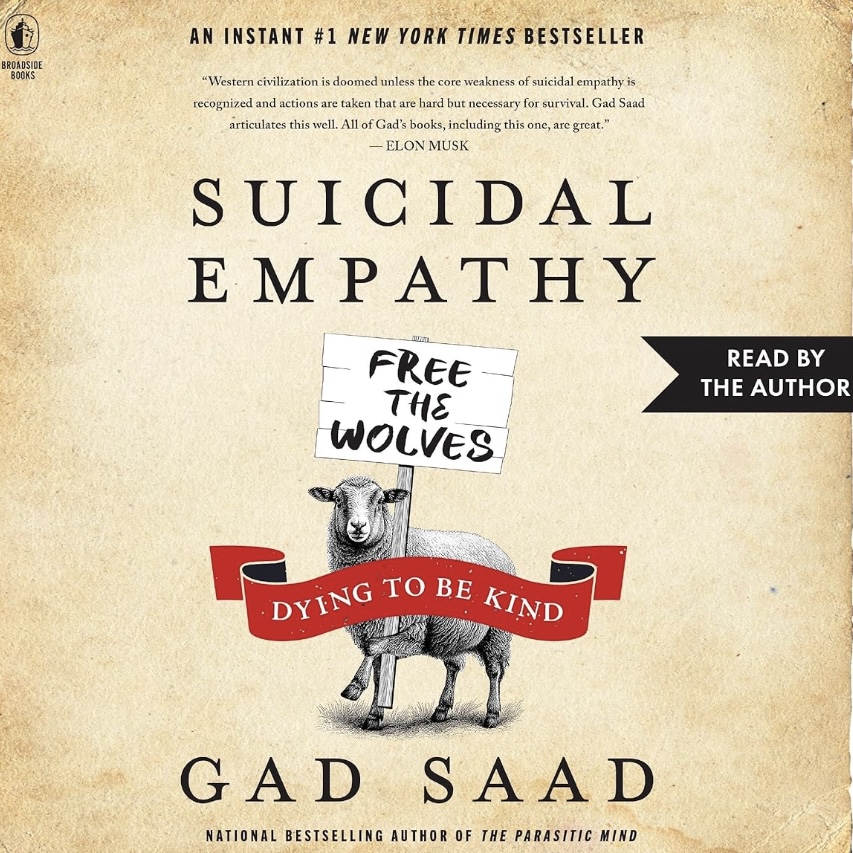
Saad sees suicidal empathy in other policies as well. The COVID-19 restrictions and mandates were another appeal to empathy that led to the rise of an authoritarian, anti-freedom, anti-Western state. There is no doubt that our constitutional rights were trampled during the pandemic, as documented in the best book I’ve read in years, In COVID’s Wake. Saad also sees suicidal empathy in climate change policies and transgender policies. The West is under attack in many ways, in Saad’s view, and what will replace it if these forces are not checked will be antithetical to Western civilization.
Saad uses vivid language to make sure his points get across. He can be quite sarcastic, and sometimes goes a bit too far in his arguments. He often quotes the incendiary writings of others, a tactic that Peter Schweizer also likes to use to build a case, as in his book The Invisible Coup. Saad also has a fondness for analyzing movies. One could easily dismiss this as arguing against fictional strawmen, although Saad would argue that Hollywood movies reflect the zeitgeist of Western society.
I don’t agree with everything Gad Saad says in Suicidal Empathy, nor do I agree with the way that he makes all of his arguments. But Saad has written a powerful defense of Western civilization and Suicidal Empathy is well worth reading. Before he passed away Christopher Hitchens made many of the same arguments, especially about Islamism, albeit in a more erudite manner. Saad’s writing style is more accessible to the masses than Hitchens’s. Because of that, and the fact that Saad is still with us and actively getting his message out, Saad’s impact will be greater. How great remains to be seen.