
|
|
posted: November 26, 2026
tl;dr: Academia was political when I was a student, but today it is hyper-political...
I remember attending a reception at the Cornell College of Engineering in my senior year, to which I and other high-G.P.A. seniors were invited. We mingled with the dean and several other professors while munching hors d'oeuvres. When the dean spoke, he told us that we were the best and the brightest of the soon-to-be-graduating class from one of the top universities in the country. As such, he encouraged us to pursue a career in academia, to do innovative research and to teach the next generation.
One reaction I had, as I glanced around at my classmates, some of whose foibles I knew, was: “Really? This is the best our country has?” I’d known a small number of true geniuses in my life at that point, people whose brains might be able to keep pace with Einstein’s, Oppenheimer’s, and Feynman’s, and this was not a room full of geniuses. But you don’t have to be a genius to be a professor, and perhaps that was the dean’s unspoken message. What you do have to be able to do is tolerate and play the game of politics, as I knew even back then.
I had already seen someone in my family struggle mightily to establish herself in an academic research position. She claimed to be doing innovative research, but often her superiors would take credit for her work. Instead of being submissive, she spoke her mind and got into several battles with the powers that be, which did not end well for her. At Cornell, there were some professors, Carl Sagan being the most famous, who were living the dream: residing in nice houses and driving fancy sports cars, jetting off to outside engagements (Sagan was often on The Tonight Show with Johnny Carson), and teaching a light load of classes while receiving adoration from the students and administration. But I also knew some post-docs who were still grinding away after having spent years earning their Ph.D. degrees, unable to land a position that would pay enough to start building a family. I was already making good money in industry as a co-op student. I will never claim that industry is free from politics, but it seemed to me that it was a lot less political, and therefore more meritocratic, than academia. I chose industry.
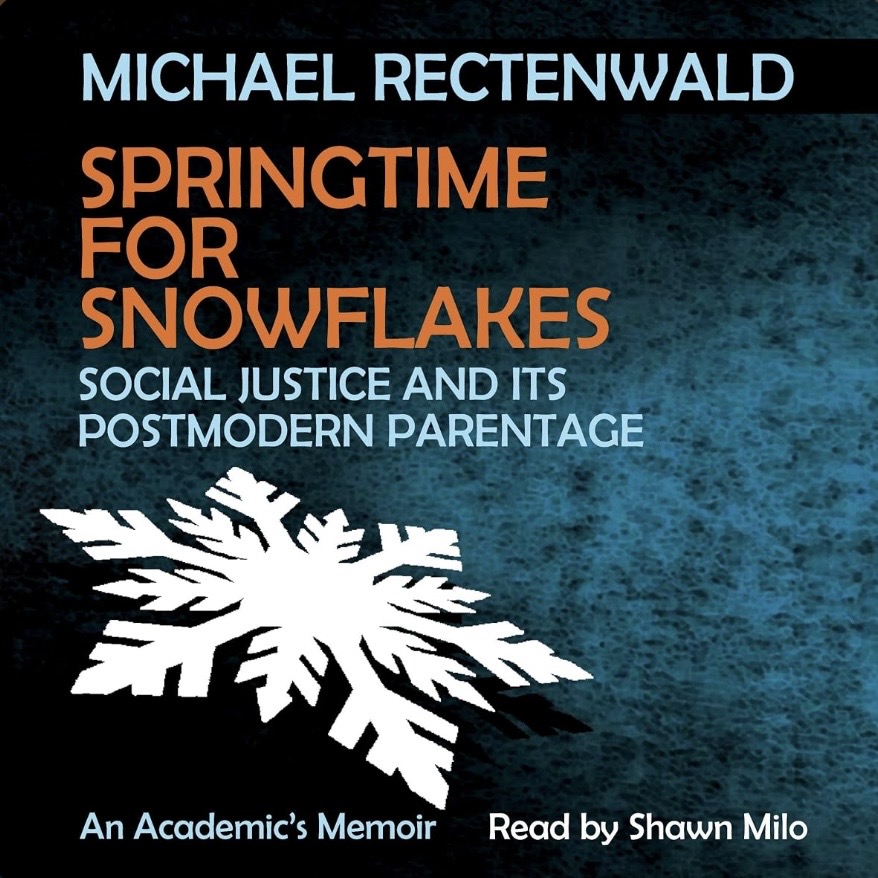
One person who chose, eventually, to go the academic route was Michael Rectenwald, author of Springtime for Snowflakes: Social Justice and its Postmodern Parentage. The first part of the book is a memoir of Rectenwald’s entry into academia, where he eventually became a professor in the English Department at New York University. As an engineering student, I was aware that the humanities were more politicized than STEM fields, and the grading was much more subjective. Rectenwald started out as a Marxist, which no doubt helped his early career, but he eventually ran afoul of the NYU administration when he started to push back against (and make sarcastic fun of) the woke garbage that crept into and eventually dominated academia. Rectenwald’s academic journey confirmed many of my feelings about academia.
But the primary reason I read Springtime for Snowflakes was to learn how, in Rectenwald’s words, “Colleges and universities have tragically abdicated their role as politically impartial and intellectually independent institutions for the advancement and transmission of knowledge and wisdom.” Where do woke, cultural Marxism, DEI, the transgender movement, and the decline of objective science come from? I had long heard that there are intellectual underpinnings for these unfortunate developments. Rectenwald offers his explanation in Springtime for Snowflakes of how intellectual thought evolved to eventually bear these bitter fruits.
The key is to reject the objective world and the rational explanations for why things are the way they are. While traditional physics does a pretty good job of explaining how to land a manned spaceship on the moon, Postmodern Theory claims that language is supreme (so the English department rules over the Physics department). Each person has their own truth based on their own particular type of subordination. Works create their authors, individual personhood is a textual production, and you are what you are named (hence gender identity). All knowledge claims, including those of science, are driven by social and political interests (hence the politicization of science and DEI). Above the structure of the rational world is a superstructure of culture and language. Change the culture and you can then change the rational world (hence cultural Marxism).
That’s my attempt to condense the arguments that Rectenwald makes across multiple chapters into a single paragraph. Rectenwald’s arguments provide a satisfying explanation for many of the maladies we see today in Western civilization. To his credit, Rectenwald ultimately rejects Marxism because of totalitarianism, historical failures, and the irrationality of an economic system with planning instead of pricing. As for me, I’m happy sticking primarily in the rational world, where I’ve managed to earn a good living over many years by applying what I learned in my STEM classes. I enjoy English literature, and fully admit that physics cannot explain everything about the human condition, and that there is a need for the humanities. But when it comes time to land a spaceship, build an economic system, or determine truth, I recommend sticking with what has been shown to work.