
|
|
posted: December 21, 2025
tl;dr: A decent selection that skews heavily in favor of guest editor Wesley Morris’s background and biases...
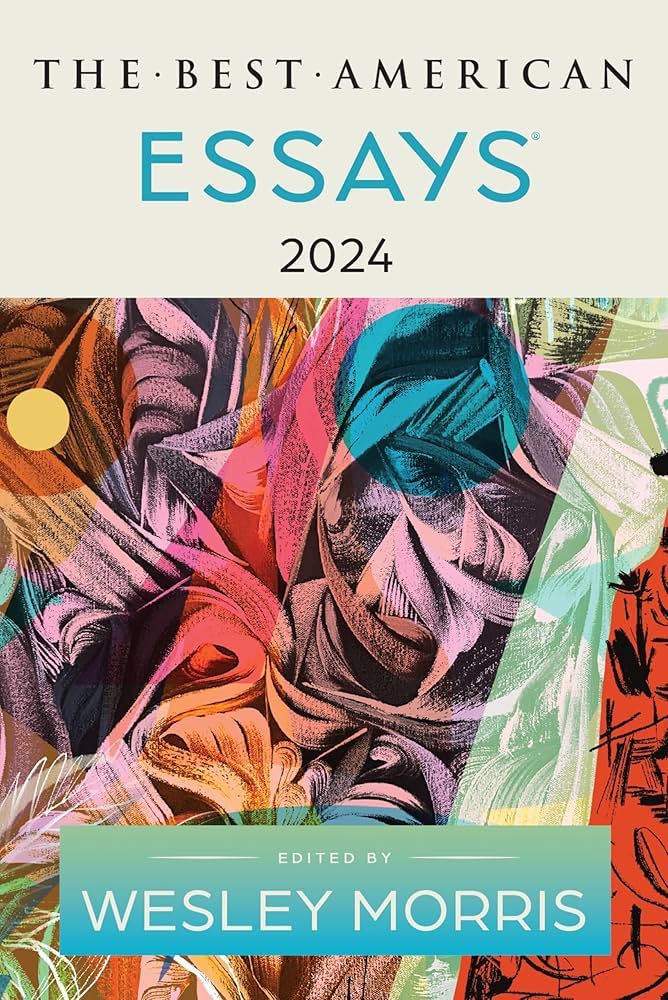
We all like stories and essays that relate to our own personal experiences. This includes The Best American Essays 2024 guest editor Wesley Morris, who made the final selection of twenty-one essays for this lengthier-than-usual volume. Why twenty-one, when the page count was already high and the usual count is twenty? I suspect that one of them is a personal selection of Mr. Morris, which is permitted under the series rules.
According to his entry on Grokipedia, Wesley Morris is a black, homosexual man. That’s perfectly fine, I have no problems with it. But when you’re the editor of an anthology series, you are supposed to make your selections based upon literary merit. Often guest editors do, as did Lauren Groff in 2024’s Best American Short Stories. But sometimes guest editors make selections that match their own backgrounds pr political leanings, as did Wesley Morris in this volume. I also enjoy reading stories and essays for people different from myself. But I wonder what well-written essays I missed reading from 2024?
That said, here are my favorite essays in The Best American Essays 2024:
“The Ones We Sent Away” by Jennifer Senior: A touching then and now story about two developmentally disabled people, describing the radically different ways they were treated and how that affected the people around them. This essays shows that the human brain is an amazingly adaptive organ, if it is given the proper stimuli.
“The Anatomy of Panic” by Michael W. Clune: I don’t think I’ve ever suffered a panic attack, so I found this essay to be especially enlightening on this topic. Like me, the author grew up in a place with a small library, and his description of the challenges of doing research using the card catalogue brought back memories.
“As Big as You Make It Out to Be” by Austin Woerner: An American student studying Chinese falls under the spell of an artistic professor who escaped the grasp of the Chinese Communist Party after the Tiananmen Square massacre. The student ends up translating one of the professor’s books, and the plot summaries provide an enchanted story within this essay. The essay also documents the student’s challenges getting started in adult life, and the subservient role of being a translator of others’ works.
The one essay I could have done without is Richard Prins’s “Because: An Etiology”. This essay uses a simple trick of starting every sentence with the word “because”. One might think that after a hundred sentences that start with “because” the author might be back at the creation of the universe, which preceded and caused everything else, but that’s not the case. There is some probing of causation, but the action jumps around in time. I got tired of the author’s trick, and felt that the tale could have been told better in another way.