
|
|
posted: August 8, 2026
tl;dr: Absolutely everyone who lived though the COVID pandemic needs to read this book...
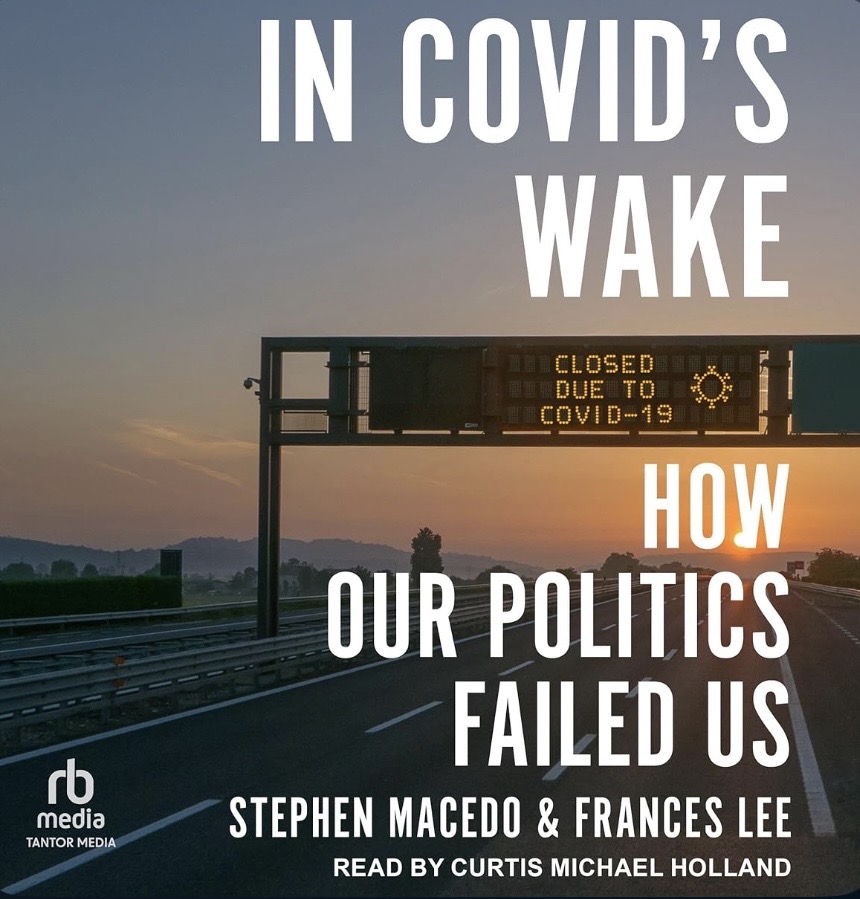
This is, quite simply, the best book I’ve read so far about what we, collectively in the United States, got wrong during the COVID-19 pandemic. The shocker is who wrote it: two self-proclaimed members of the educated liberal elite, the same class of people who dominate our academic and educational institutions, the mainstream media, our public health institutions, our government bureaucracies, and non-government organizations. Authors Stephen Macedo and Frances Lee aren’t afraid to criticize their comrades: “We believe that our own tribe needs to introspect, admit its biases and shortcomings, and strive to do better.” “Elite groups have tendencies towards groupthink and mutual reinforcements of biases, fed by a self-righteous sense of moral and intellectual superiority.” Punches landed, but look who is throwing them.
Regarding the origin of COVID, a topic of considerable (obsessive?) interest to me, the authors state there was “an astonishing degree of politicization, significant undisclosed conflicts of interest, and apparent deception, all compounded by a media environment that censored and suppressed opinions diverging from government sources.” I couldn’t have said it better myself. The authors go into the lab leak coverup in depth, summarizing the construction of the natural origin narrative and the suppression of the lab leak theory as: “Whatever this is, it’s not science.”
The authors actually have some true compassion for those less fortunate than themselves: the poor and the working classes in the United States, and people living in less-developed nations. They point out how these people were harmed much more than those, like themselves, in the laptop class. I saw this firsthand in my own family. When the pandemic hit, I just worked from my laptop at home, while others in my family never missed a day of in-person work: they were just told to wear a mask, and were given a letter they could produce if stopped by police, declaring that they were an “essential worker” and hence expected to be out where the virus was circulating. The essential workers were actually the expendable workers.
All the major mistakes made in the response to the pandemic are discussed in the book: masking, inaccurate modeling, school closures, lockdowns, the denigration of natural immunity, social media censorship, and the rise in public debt, inflation, unemployment, inequality, and hunger in Third World countries. Macedo and Lee show there was pre-existing science on how to respond to a respiratory virus pandemic, and claim Sweden followed it most closely and had one of the best outcomes. But when the World Health Organization traveled to Wuhan and saw the severe Chinese lockdowns, and then Italy proved that draconian policies could be implemented in a Western democracy, that became the new standard. There were dissenters, but they were shouted down. Now, as of the time of the book, the “proponents of these policies have yet to come to grips with the severe costs of the lockdowns… some remain defiantly resistant to criticism of the policies that they advocated.”
There is plenty of blame to go around, and the authors do not put it all on our public health officials. The authors cite the same quote made by NIH Director Francis Collins in a forum with Wilk Wilkinson (“you attach infinite value to…saving a life”) that I quoted in this blog post, demonstrating how shortsighted public health officals are. Rather, the primary blame lies with the politicians who deferred to the public health officials and who thereby failed to properly balance the multiple interests that exist in society, such as the interest of children to be educated. Hence the book’s subtitle, “How Our Politics Failed Us.” I concur with the author’s assessment. We needed more governors like Ron DeSantis, and more representatives in Congress like Rand Paul. As Macedo and Lee say, “experts should always be on tap, never on top.”